10 Best Grade 304L Stainless Coils Suppliers Worldwide
Choosing reliable Grade 304l Stainless Coils suppliers requires more than comparing prices on a company website. Buyers must examine production experience, material consistency, certification, export performance, and technical support. A dependable supplier should clearly state coil thickness, width tolerance, surface finish, edge condition, and mechanical properties. Mill test certificates should accompany each shipment. Independent testing can provide additional confidence.
This guide reviews ten international suppliers serving construction, food processing, medical equipment, automotive, and industrial markets. Their capabilities may differ significantly. Some specialize in large-volume orders, while others offer custom slitting, narrow widths, or faster delivery. Production details matter. A clean 2B surface, secure steel strapping, and moisture-resistant packaging can prevent costly damage during ocean transport.
Experience matters here.
Supplier evaluation also requires practical judgment. Online claims are not always current, and published lead times may change during peak demand. Buyers should confirm current capacity, minimum order quantities, payment terms, and after-sales responsibility before signing a contract. Factory audits, sample inspections, and traceable documentation can reveal weaknesses that marketing materials conceal. No supplier is ideal for every application. That is worth remembering.
The following selection focuses on technical credibility, manufacturing resources, quality controls, customer responsiveness, and global delivery reliability. It is not a permanent ranking. Market conditions evolve, and a supplier’s performance may vary by region, order size, or product specification. Careful verification remains essential for every purchase.
What Grade 304L Stainless Steel Coils Are
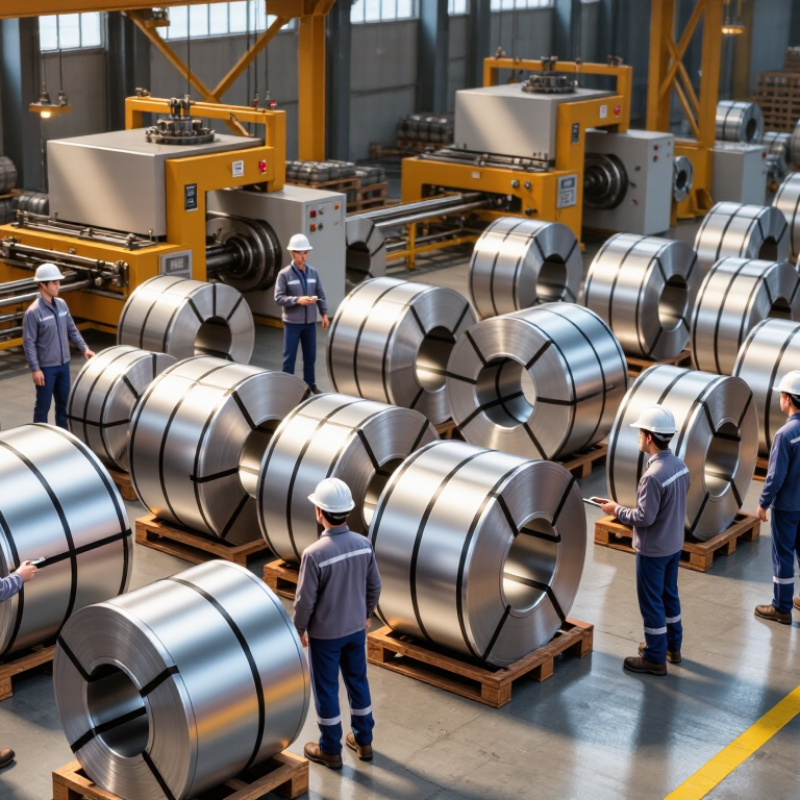
Grade 304L stainless steel coils are flat-rolled, corrosion-resistant strips wound into compact rolls for processing. The “L” means low carbon, with a maximum carbon content commonly limited to 0.03%. This reduces carbide precipitation during welding and helps protect corrosion resistance near welded areas.
Typical 304L chemistry includes approximately 18–20% chromium and 8–12% nickel. Chromium forms a thin passive film, while nickel supports ductility and stable performance during forming. These coils are often supplied in annealed and pickled conditions, with finishes selected for appearance, cleaning, or fabrication needs. Thickness, width, coil weight, edge condition, and surface quality should match the intended equipment.
In practical use, 304L performs well in food-processing equipment, architectural panels, tanks, and general manufacturing. It can be bent, stamped, and welded with suitable procedures. However, it is not an ideal choice for every environment. Warm chloride solutions may cause pitting or stress corrosion cracking, especially when surfaces remain wet. A bright surface can mislead.
When evaluating a coil, buyers should review the material test certificate, heat number, chemical analysis, mechanical properties, and dimensional tolerances. Independent testing may be worthwhile for critical projects. Surface scratches, rolled-in scale, and uneven edges can create problems later, even when the grade is correct. Specification decisions sometimes focus too much on the alloy name and not enough on service conditions.
How Grade 304L Coil Quality Is Measured
How Grade 304L Coil Quality Is Measured
Grade 304L stainless coil quality begins with verified chemical composition. Carbon should remain low, commonly at or below 0.03%, to support welding performance. Chromium and nickel levels must match the applicable specification. A positive material identification test can confirm the alloy quickly, but it cannot replace laboratory analysis.
Mechanical testing examines yield strength, tensile strength, and elongation. These results show whether the coil can survive forming without unexpected cracking. Thickness, width, flatness, and edge condition are also measured across the coil. Small variations may become serious during stamping or slitting. The surface should be checked for scratches, pits, roll marks, and embedded particles. Looks can deceive.
Corrosion performance depends on processing as well as chemistry. Proper annealing and pickling help restore a clean, passive surface. Roughness readings are useful when the coil will enter sanitary or decorative applications. Inspectors should compare test results with the purchase specification, not with appearance alone. Heat numbers, inspection reports, and sampling records provide traceability from production to delivery. One sample is not enough. Even careful inspections can miss defects between tested sections, so sampling plans deserve regular review.
How to Compare Prices, Certifications, and Delivery Services
When comparing Grade 304L stainless coil suppliers, compare landed cost, not the headline price. Request identical specifications: thickness, width, surface finish, coil weight, tolerance, and quantity. A useful price sheet separates material, slitting, packaging, inland transport, insurance, and ocean freight. The International Stainless Steel Forum reported 58.4 million tonnes of stainless crude steel production in 2023. That scale creates competition, but not identical quality.
Certifications need verification. Ask for an ISO 9001 certificate, EN 10204 3.1 material certificates, and compliance with ASTM A240/A240M or the agreed regional standard. Check heat numbers against coil labels and test reports. For 304L, confirm the low-carbon chemistry, mechanical results, and traceability. A scanned certificate alone is weak evidence. Request independent inspection when the order value justifies it.
Delivery comparisons should include production time, port handling, transit time, and customs risk. UNCTAD’s Review of Maritime Transport 2024 recorded 2.4% growth in maritime trade during 2023, while disruptions continued to affect schedules. Ask suppliers for recent on-time delivery data, not promises. Stock coils may ship quickly, but custom widths can require several weeks. The method is imperfect. Weather, port congestion, and rejected tests can change the real date. A clear penalty clause and written inspection plan reduce unpleasant surprises.
304L Stainless Steel Coil Supplier Comparison: Technical Baseline
Use this ASTM A240/A240M Type 304L chemical-composition baseline when comparing supplier test certificates. Price, certification validity, coil dimensions, and delivery terms should be evaluated separately.
Reference values are maximum limits or specified ranges for Type 304L stainless steel plate, sheet, and strip under ASTM A240/A240M. Chromium and nickel are shown at their specified upper limits; other elements are shown at their maximum permitted values.